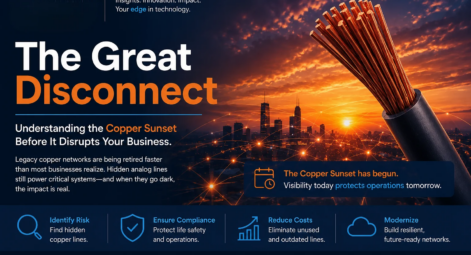
For years, the retirement of traditional copper phone lines felt like a future problem. Businesses knew it was coming, but many assumed they would have plenty of warning and plenty of time to respond.
That assumption is becoming increasingly risky.
Copper retirement activity continued to accelerate throughout 2026. Verizon has published new copper retirement notices covering locations in Florida, Indiana, Nebraska, North Carolina, Texas, Wisconsin and other states. Its network disclosures also list numerous switch retirements across the Northeast and Mid-Atlantic. AT&T reported that it has approval to discontinue legacy services in more than 30% of its wire centers, with those approvals expected to take effect by late 2026.
The copper sunset is no longer an industry talking point. It is happening wire center by wire center, building by building and circuit by circuit.
A 90-Day Notice Is Not a 90-Day Migration Plan
The Federal Communications Commission’s copper-retirement process generally allows a retirement notice to become effective 90 days after the FCC releases public notice of the filing when customers are still being served. Facilities that are no longer being used to provide service may move through the process more quickly.
That does not mean every business will receive a simple letter giving it exactly 90 days to complete a migration. FCC network-change notices are part of the carrier and competitive-provider process. Customer communications, service-discontinuance procedures and actual retirement dates can vary.
The practical lesson is straightforward: businesses should not build their migration strategy around the arrival of a notice.
Ninety days can disappear quickly when an organization must identify every analog line, determine what it supports, review local code requirements, coordinate property managers and vendors, schedule installation, test emergency calls and document the final configuration.
For an enterprise with dozens or hundreds of locations, the real migration window may have opened long before anyone noticed.
The Line Nobody Recognizes May Be the Most Important One
The desk phones are usually not the hardest part of a copper migration. Most organizations have already moved employee calling to SIP, UCaaS or another cloud voice platform.
The greater risk sits in the lines that rarely attract attention:
- Fire alarm panels
- Elevator emergency phones
- Security and burglar alarms
- Emergency and blue-light phones
- Fax machines
- Building entry systems
- Point-of-sale devices
- Intercoms
- Gate controls
- Modems and telemetry equipment
These connections often remain hidden inside telecom invoices under old circuit descriptions or unfamiliar telephone numbers. A business may continue paying for a line without knowing where it terminates or whether the connected equipment is still operational.
That creates a dangerous combination: rising cost, limited visibility and critical equipment that may not be discovered until the line fails.
Why Standard VoIP Is Not Always the Answer
Replacing an analog line is not simply a matter of finding a less expensive dial tone.
Many legacy devices were designed around the electrical characteristics of a traditional copper circuit. They may depend on specific line voltage, signaling, modem tones, fax protocols or call-routing behavior. Fire alarms and elevator phones also introduce life-safety standards, battery requirements and local authority having jurisdiction considerations.
TelCloud describes modern cloud POTS replacement as a way to preserve the “last foot” of analog connectivity. A specialized adapter presents the voltage and signaling the legacy equipment expects while calls travel over modern IP or wireless infrastructure. The architecture can include an analog telephone adapter, an LTE-enabled router and battery backup.
That distinction matters. A standard voice adapter may work for a basic telephone but still be the wrong choice for an alarm panel, elevator phone or modem-based device.
The goal is not merely to make the device produce a dial tone. The goal is to make sure the full communication path works when it is actually needed.
BCN’s Perspective: Start With the Application, Not the Product
At BCN, we do not view POTS replacement as a one-product exercise.
The right replacement depends on what the line supports, how critical the application is, what connectivity is available at the location and which compliance requirements apply. A fire panel, fax machine and ordinary voice line may all use analog service today, but they do not necessarily belong on the same replacement architecture.
BCN’s POTS replacement portfolio includes:
- POTS Over LTE for alarms, elevator phones, emergency systems, fax machines, voice lines and other analog devices
- Cloud Voice and UCaaS for organizations ready to modernize traditional business calling
- SIP and SIP PRI for businesses that want to preserve an existing PBX while moving away from legacy transport
- Cable Voice where a cable-based analog replacement is appropriate
This application-first approach helps prevent businesses from forcing every analog endpoint into the same technical box.
What Makes BCN POTS Over LTE Different?
BCN POTS Over LTE is a fully managed and monitored solution designed for critical analog applications.
The solution uses an MFVN-compliant analog telephone adapter that can support up to eight lines. Dual-SIM 4G LTE provides primary connectivity, while SD-WAN-enabled wired, broadband or Wi-Fi options can add another path where appropriate. The system includes eight hours of battery backup, with an optional enclosure and up to 24 hours of backup available.
BCN also manages the communication path from the customer premises through the BCN-managed softswitch and into the public telephone network. Integrated monitoring provides visibility into individual lines and can generate alerts for proactive repair management.
Other capabilities include:
- Support for fire and life-safety applications
- Remote power cycling
- Traffic shaping and quality-of-service management
- Built-in firewall protection
- T.38 and store-and-forward fax capabilities
- Flexible router placement to improve LTE signal strength
- White-glove installation
- Post-installation photographs and documentation
- Proof of successful test calls
- Unified support and billing across multiple locations
The open-enclosure design also allows individual components to be updated or replaced. Businesses are not locked into a sealed device that becomes another piece of unmanaged equipment sitting on the wall.
A Better Migration Begins with an Inventory
Before selecting a replacement service, businesses should answer five questions:
- Which locations still have analog lines?
- What device is connected to each line?
- Is the device used for life safety, compliance or emergency communication?
- What backup power and connectivity are available at the site?
- Who will test, approve and document the replacement?
The invoice alone will not answer every question. A complete audit may require billing analysis, physical site inspections, telephone-number tracing and coordination with alarm, elevator or building-management vendors.
Multi-location organizations should also monitor carrier retirement activity rather than waiting for individual notices to arrive.
The BCN POTS Retirement Tracker provides an interactive way to explore announced copper-retirement activity and identify locations that may require a closer look.
Copper Retirement Is a Business-Continuity Project
The copper sunset is not simply a telecom upgrade. It touches facilities, risk management, compliance, finance, IT and operations.
Organizations that treat it as a last-minute circuit replacement may trade one aging line for a poorly understood alternative. Organizations that begin with a complete inventory can reduce unnecessary costs, strengthen resiliency and build a repeatable migration plan across every location.
Copper may be disappearing one notice at a time, but businesses do not have to respond one emergency at a time.
BCN can help identify existing POTS lines, match each application to the appropriate replacement, coordinate installation and provide ongoing management through one experienced provider.
Explore the BCN POTS Over LTE solution or visit www.bcntele.com to begin planning your migration.
Sources: FCC copper-retirement guidance, Verizon network disclosures, AT&T 2026 earnings remarks, TelCloud POTS Replacement Guide and BCN POTS Over LTE.