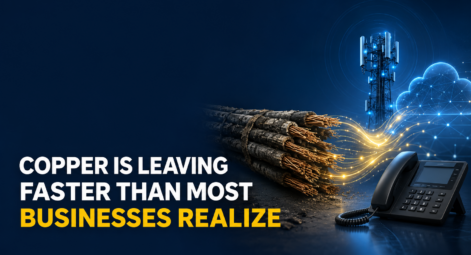
For years, organizations have heard about the Copper Sunset. Many assumed it was still years away. It isn’t. The conversation has shifted from if legacy copper networks will disappear to how quickly communications providers can retire them. As carriers continue investing in fiber, wireless, and IP-based infrastructure, maintaining decades-old copper networks has become increasingly unsustainable. Across the industry, legacy analog services are being phased out region by region, accelerating one of the most significant infrastructure transitions businesses have faced in decades. For organizations still relying on analog infrastructure, this isn’t simply another technology refresh. It’s a business continuity issue.
Copper Isn’t Just Your Phone Line Anymore
Many organizations believe they’ve already moved beyond traditional telephone service because employees use Microsoft Teams, Zoom, or cloud voice platforms. Yet hidden throughout nearly every facility are analog connections quietly supporting mission-critical operations: • Fire alarm panels • Elevator emergency phones • Security and access control systems • Fax machines • Emergency call boxes • Building management systems • Point-of-sale backup lines • Healthcare communications • Industrial monitoring equipment These systems rarely receive attention—until they stop working.
The Cost of Waiting Has Changed
Reactive planning is becoming an increasingly expensive strategy. Waiting can create unexpected service disruptions, compliance concerns, emergency replacement costs, limited migration options, operational downtime, and increased business risk. Organizations that begin planning before retirement notices arrive retain greater flexibility and significantly less operational disruption.
Compliance Doesn’t Disappear Because Copper Does
Many organizations depend on analog connectivity to meet regulatory requirements for life-safety and emergency communications. Replacing a telephone line is relatively straightforward. Replacing an entire compliance ecosystem without careful planning is not.
Rising Costs Are Already Sending a Message
Many businesses discover they’re paying for unused analog circuits, duplicate services, forgotten locations, legacy backup lines, and equipment that’s no longer connected. The result is often thousands of dollars each month supporting infrastructure that no longer delivers meaningful business value.
Visibility Is the Biggest Challenge
Years of acquisitions, office relocations, carrier changes, facility renovations, and incomplete documentation make it difficult to know where every analog line exists. For many enterprises, the first step toward modernization isn’t replacing copper—it’s finding it.
See Your Risk Before Your Carrier Does
BCN developed the POTS Retirement Tracker to help businesses monitor copper retirement activity across the United States. The tracker enables organizations to: • Monitor retirement activity by location • Identify geographic trends • Understand carrier activity • Support migration planning • Improve executive visibility into infrastructure risk Explore: BCN POTS Retirement Tracker.
The Great Disconnect Requires More Than a Quick Fix
Forward-thinking organizations are using the Copper Sunset as an opportunity to modernize their broader communications infrastructure through LTE and wireless POTS replacement, cloud-managed connectivity, SD-WAN, business continuity, centralized visibility, managed lifecycle support, proactive monitoring, and secure IP communications. The result isn’t simply replacing copper—it’s improving resiliency, security, and long-term flexibility.
The Technology Matters Less Than the Strategy
Successful organizations begin with assessment—not assumptions. They inventory analog dependencies, identify critical systems, understand carrier retirement timelines, and develop phased migration plans. Technology follows strategy, not the other way around.
From Copper Replacement to Infrastructure Resilience
Across the industry, businesses are replacing aging analog circuits with IP-based and wireless alternatives that improve reliability, simplify management, and reduce long-term operational costs. At BCN, we believe organizations deserve more than a replacement for aging technology. They deserve a long-term strategy. Whether that includes managed POTS replacement, resilient wireless connectivity, SD-WAN, or broader network transformation, the objective remains the same: ensure uninterrupted communications while simplifying legacy infrastructure.
The Bottom Line
The Copper Sunset isn’t simply the retirement of an aging technology. It’s one of the most significant infrastructure transitions businesses will face this decade. The question is no longer whether copper is going away. The question is whether your organization is ready for The Great Disconnect.
Call to Action
Explore BCN’s free POTS Retirement Tracker to monitor copper retirement activity across the United States, identify potential risks, and begin planning with confidence. Learn more about BCN’s managed POTS Replacement solutions and network modernization expertise at www.bcntele.com.