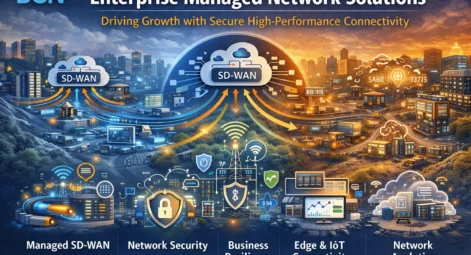

A TechEdge Special Edition Featuring Chris Alberding (BCN) & Bernard Breton (Adaptiv Networks)
SD-WAN has officially moved beyond early adoption. It is no longer a technology experiment or a cost-reduction tool. It has become foundational infrastructure.
In this special TechEdge edition, Chris Alberding, CPO of BCN, sits down with Bernard Breton, CEO of Adaptiv Networks, to discuss how the SD-WAN market is evolving and what will define leadership over the next three to five years.
SD-WAN: From Upgrade to Business Requirement
Chris Alberding: SD-WAN has clearly moved past the early adoption phase. From your perspective, what defines the current state of the market?
Bernard Breton: The most important shift is that SD-WAN is no longer being evaluated as a technology upgrade it’s being evaluated as a business requirement. Early conversations focused on replacing MPLS or improving routing. Today, organizations are asking a different question: Can our network support cloud applications, remote users, and business growth without adding complexity?
Buyers are more informed. Expectations are higher. SD-WAN is now expected to be reliable, secure, and simple by default.
Modernization Without Disruption
Chris Alberding: At BCN, we see customers prioritizing minimal disruption. How does that shape modern SD-WAN design?
Bernard Breton: The future of SD-WAN is evolutionary, not revolutionary.
Organizations want the freedom to modernize without being forced into a rip-and-replace scenario. Some want SD-WAN alongside existing firewalls. Others prefer an integrated networking and security platform. Technology must support both paths. Forcing customers into a single architecture creates resistance. Supporting flexibility accelerates adoption.
The Convergence of Networking and Security
Security is now inseparable from networking conversations.
Chris Alberding: Security is tightly linked to SD-WAN conversations now. How do you see that evolving?
Bernard Breton: Security and networking are converging but complexity should not increase as a result.
The real opportunity is to simplify security operations while improving protection.
Cloud-based security integrated directly into the SD-WAN fabric is where the market is headed. That means:
- Centralized policy enforcement
- Consistent protection across sites and users
- Reduced dependence on hardware appliances
What customers don’t want is another stack of tools to manage.
Remote Work Is Permanent Infrastructure
Remote access is no longer a secondary feature, it’s core infrastructure.
Chris Alberding: Remote work has fundamentally changed networking. What trends are you seeing around remote access and SD-WAN?
Bernard Breton: Traditional VPNs were built for occasional use. Today’s distributed workforce is always on.
Modern SD-WAN extends secure connectivity directly to users, treating them as part of the network rather than exceptions to it. Performance, security, and policy enforcement must be consistent regardless of location.
This shift isn’t temporary. Platforms that fail to treat remote access as a first-class capability will struggle to remain relevant.
Why Simplicity Is the Ultimate Differentiator
Chris Alberding: BCN focuses heavily on simplicity. Why is simplicity becoming such a competitive advantage?
Bernard Breton: Because complexity doesn’t scale.
IT teams are under pressure to do more with fewer resources. Every additional console, policy model, or manual process becomes a liability.
The most successful SD-WAN platforms abstract complexity rather than expose it. Centralized orchestration, intent-based policies, and automation are no longer “nice to have.” They are requirements.
In the future, the best SD-WAN solutions will be the ones customers barely have to think about.
Intelligence Over Infrastructure
Chris Alberding: There is ongoing debate about private backbones versus intelligent use of the public internet.
Bernard Breton: The industry is moving toward intelligence over infrastructure.
Rather than relying on proprietary backbones, modern SD-WAN platforms use real-time performance monitoring and dynamic routing across multiple high-quality networks.
The focus is shifting from where traffic goes to how well it performs.
This approach reduces lock-in, lowers cost, and aligns better with how cloud services are delivered today.
What Will Define Market Leadership?
Chris Alberding: Looking ahead three to five years, what will define leadership in the SD-WAN market?
Bernard Breton: Leadership will be defined by outcomes, not features.
Organizations will choose platforms that deliver:
- Consistent performance
- Integrated security
- Operational simplicity
- Architectural flexibility
Ultimately, SD-WAN will become invisible infrastructure; quiet, reliable, and always on.
That’s when it has truly succeeded.
Final Thought
When asked to summarize the future of SD-WAN in one sentence, Bernard put it simply:
“SD-WAN is becoming the foundation that allows businesses to grow, adapt, and secure their networks without ever having to think about the network itself.”
Closing Perspective
The evolution of SD-WAN reflects a broader shift in enterprise IT from managing infrastructure to enabling outcomes.
As networks become more critical and more complex behind the scenes, the value of simplicity, flexibility, and intelligent design has never been greater.
For organizations navigating cloud adoption, remote work, and growth, SD-WAN is no longer optional.
It is the foundation.
About the Participants
This TechEdge Special Edition featured insights from Chris Alberding, Chief Product Officer at BCN, and Bernard Breton, Chief Executive Officer of Adaptiv Networks.
To learn more about their organizations:
- BCN: https://www.bcntele.com
- Adaptiv Networks: https://www.adaptiv-networks.com
TechEdge thanks both leaders for sharing their perspectives on how SD-WAN is evolving from a networking upgrade to essential business infrastructure.
As the market continues to mature, conversations like this help define what leadership truly looks like in the next era of connectivity.