
Published by BCN Telecom | Your Trusted Partner in Managed Network Technology Solutions
If you are leading IT or network strategy today, you have likely heard the term hybrid connectivity. But what does it actually mean in practical technical terms?
It means enterprises are no longer choosing between private networks and public networks. Instead, they are designing architectures that intelligently combine both to create a unified, secure, high performance global network.
This convergence is becoming the foundation of modern enterprise WAN strategy.
What Private and Public Network Convergence Really Means
Private networks deliver control, segmentation, predictable performance, and strong security within enterprise environments. Public broadband and dedicated internet services deliver geographic reach, scalability, and cost efficiency.
The convergence happens when these environments are unified through:
· Multi carrier connectivity
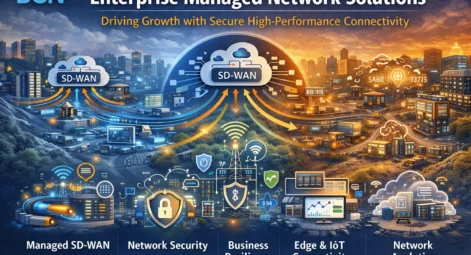
· Intelligent SD WAN overlays
· Cloud delivered security frameworks such as SASE
· Centralized orchestration and monitoring
In a converged architecture, fiber, broadband, fixed wireless, LTE, and 5G are no longer treated as isolated services. They become integrated transport layers under a single policy driven network fabric.
This is where hybrid networking becomes operational rather than conceptual.
SD WAN as the Intelligence Layer
At the center of convergence is SD WAN.
SD WAN abstracts the underlying transport layer and builds an intelligent overlay across multiple connections. Instead of relying on static routing, the network dynamically selects the best path based on:
· Latency
· Jitter
· Packet loss
· Application priority
· Security policy
This allows enterprises to:
Prioritize mission critical applications Optimize SaaS and cloud performance Segment traffic between sites Maintain consistent user experience across diverse access types
When broadband, dedicated internet, and wireless links are managed through SD WAN, private and public networks function as one cohesive system.
Security in a Converged Environment
As networks become hybrid, security must become unified.
Modern architectures integrate secure access frameworks that combine networking and security into a cloud delivered model. In practical terms, this enables:
· Centralized policy enforcement
· Zero trust segmentation
· Secure remote access
· Data aware traffic inspection
· Consistent enforcement across all sites
Security is no longer tied to a physical perimeter. It follows identity, device, and application context across private circuits, broadband connections, wireless links, and international locations.
This is critical for enterprises operating across multiple carriers and geographies.
The Importance of Multi Carrier Global Connectivity
Global enterprises require consistent performance across regions, not just within a single country.
Multi carrier connectivity strategies allow organizations to:
· Source local connectivity in international regions
· Reduce latency through regional breakout
· Implement multi region redundancy
· Maintain centralized monitoring across global sites
· Consolidate service management and billing
Instead of managing separate contracts and architectures in each country, enterprises operate within a consolidated global connectivity model.
Multi carrier strategies also enable extended roaming and seamless transition between private and public environments without disrupting services.
What a Converged Architecture Looks Like in Practice
Consider a typical deployment.
Headquarters
- Primary: Dedicated Internet or Private Fiber
- Secondary: Cable/Fiber Broadband or 5G Fixed Wireless
- Tertiary: 5G/4G LTE wireless failover
- SD WAN edge device
- Cloud delivered security enforcement
Branch Location
- Primary: Cable or Fiber Broadband
- Secondary: 5G Fixed Wireless
- Tertiary: 5G/4G LTE backup
- Application aware SD WAN routing
- Centralized monitoring
International Site
- Primary: Local fiber or dedicated internet
- Secondary: Regional broadband or 5G wireless
- Tertiary: 5G/4G LTE backup
- Integration into global SD WAN fabric
- Unified security policies
- Centralized performance visibility
Why Enterprises Are Moving Toward Hybrid Architectures
This shift is driven by real operational demands:
· Cloud first application strategies
· Distributed and remote workforces
· Rapid expansion into new markets
· Increased security and compliance requirements
· Demand for uptime guarantees
· Desire to reduce carrier management complexity
Hybrid architectures solve these challenges by combining performance, flexibility, and global scalability.
For enterprise IT leaders, convergence delivers:
The Strategic Impact
· Simplified WAN architecture
· Faster site deployment
· Improved resiliency and failover
· Unified policy enforcement
· Optimized cloud connectivity
For service providers, it represents a shift from selling bandwidth to delivering orchestrated connectivity ecosystems that integrate transport, security, and management.
Connectivity is no longer just about circuits. It is about intelligence, orchestration, security, and global integration.
Final Thoughts
The convergence of private and public networks is not a future concept. It is actively reshaping enterprise WAN design.
Modern enterprise networks are:
· Resilient
· Secure
· Globally scalable
· Application aware
· Centrally orchestrated
The question is no longer whether to choose private or public. The future belongs to architectures that intelligently combine both.