
AI Receptionists: The Network Infrastructure Required to Power Them
Published by BCN Telecom | Your Trusted Partner in Managed Network Technology Solutions
In today’s digital-first business environment, customers expect instant responses, accurate information, and 24/7 availability. Across industries—including healthcare, retail, finance, education, hospitality, manufacturing, and government—organizations are implementing AI receptionists to modernize inbound communications and elevate customer experience.
However, the success of an AI receptionist depends on one critical factor:
A secure, scalable, high-performance network infrastructure.
Below, we explore how AI receptionists work, the industries benefiting most, and the managed network solutions required to support them.
What Is an AI Receptionist?
An AI receptionist is a conversational AI-powered system that uses natural language processing (NLP), intelligent call routing, and voice automation to handle inbound business calls without human intervention.
Modern AI reception systems can:
- Answer and interpret inbound calls using natural speech recognition
- Provide instant responses to FAQs (business hours, pricing, directions, scheduling)
- Capture leads and eliminate missed calls
- Route callers by department, skillset, or availability
- Integrate with CRMs, scheduling software, and helpdesk platforms
- Support multilingual communication
- Deliver analytics on call volume, caller intent, and service outcomes
These capabilities help businesses reduce operational costs while improving responsiveness and customer satisfaction.
Industries Transforming Communication with AI Receptionists
Healthcare
- Appointment scheduling
- Patient triage routing
- HIPAA-compliant communication
Retail & eCommerce
- Order status updates
- Product inquiries
- Returns and support automation
Finance & Banking
- Client service routing
- Branch-level call management
- Secure account inquiries
Hospitality & Travel
- Reservation management
- Guest services automation
- Multi-language assistance
Manufacturing, Government & Education
- Vendor and supplier communication
- High-volume public inquiries
- Multi-location coordination
AI-driven voice automation is rapidly becoming a competitive advantage across both private and public sectors.
The Critical Requirement: Enterprise-Grade Network Infrastructure
AI receptionists operate in real time. Without high-performance connectivity, even the most advanced conversational AI system will fail.
Here’s what your infrastructure must deliver:
1. High-Quality Voice Connectivity
AI voice systems depend on:
- Low latency
- Minimal jitter
- Stable VoIP and SIP trunking
- Clear audio packet delivery
Poor connectivity results in delays, dropped calls, and misinterpreted speech—damaging customer experience.
2. Scalable, Redundant Internet Access
Most AI reception platforms operate in the cloud. To ensure uninterrupted service, businesses need:
- Fiber or high-bandwidth broadband
- LTE/5G failover
- Redundant circuits
- SD-WAN for intelligent traffic routing
Network redundancy ensures your AI receptionist remains operational—even during outages.
3. Security & Compliance
AI systems process sensitive voice and data traffic. A secure network must include:
- End-to-end encryption
- Network segmentation
- Firewall and threat detection
- Compliance-ready architecture (HIPAA, PCI, SOC 2, etc.)
For regulated industries, compliance is not optional—it is mandatory.
4. Unified Voice Platform Integration
AI receptionists perform best when integrated with:
- SIP trunking
- UCaaS (Unified Communications as a Service)
- Hosted PBX systems
- CRM and ticketing platforms
A managed network provider ensures seamless integration across platforms and locations.
5. Real-Time Monitoring & Performance Optimization
Continuous network monitoring enables:
- Call quality analytics
- Bandwidth optimization
- QoS configuration
- Proactive issue detection
This ensures consistent AI performance and uninterrupted customer communication.
Why Partner with a Managed Technology Solutions Provider?
Because AI depends entirely on network performance, businesses are increasingly working with managed network service providers to support AI deployment.
A managed provider delivers:
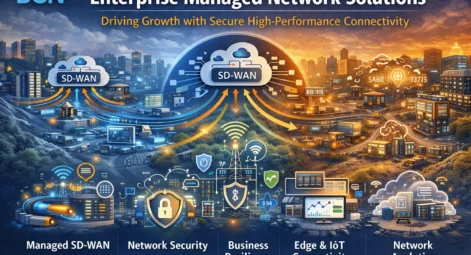
- Managed connectivity (fiber, broadband, LTE/5G, satellite)
- SIP trunking and cloud voice solutions
- SD-WAN for intelligent routing and Quality of Service
- Network security and compliance management
- Multi-location integration
- 24/7 monitoring and proactive support
With the right infrastructure foundation, an AI receptionist becomes more than automation—it becomes a strategic customer experience asset.
The Bottom Line: AI Performance Starts with Network Performance
AI receptionists are transforming how businesses handle inbound communication. But without secure, scalable, high-performance connectivity, their effectiveness is limited.
Investing in managed network technology ensures your AI systems operate with:
- Speed
- Reliability
- Security
- Scalability
If you’re considering implementing an AI receptionist—or want to optimize your current infrastructure—partnering with an experienced managed technology solutions provider is the key to long-term success.
Ready to Future-Proof Your Communications Infrastructure?
Discover how modern managed network solutions can power your AI receptionist and elevate your customer experience.